ECG vs Heart Rate Monitoring: Understanding the Difference and Why It Matters for Your Health
ECG vs Heart Rate Monitoring
Understanding the Critical Difference
Why not all heart monitoring is created equal
If you're shopping for a smart ring or wearable health device, you've likely encountered two terms: heart rate monitoring and ECG (electrocardiogram). While both relate to heart health, they measure fundamentally different things—and understanding the distinction could be crucial for your health.
In this comprehensive guide, we'll break down exactly what each technology measures, what it can (and cannot) tell you about your health, and why this matters when choosing a device like the Oura Ring or an ECG-enabled smart ring.
🔬 The Short Answer
- Heart rate monitoring = How fast your heart is beating
- ECG monitoring = How well your heart is beating (electrical activity)
Both are valuable, but they provide different insights. Here's why that matters.
Heart Rate Monitoring: The Basics
Heart rate monitoring is the most common form of cardiac tracking in wearable devices. It measures the number of times your heart beats per minute (BPM).
How It Works
Most wearable devices use photoplethysmography (PPG)—a technology that uses light to detect blood volume changes in your capillaries. Green LED lights shine into your skin, and sensors measure how much light is absorbed or reflected with each heartbeat.
What Heart Rate Monitoring Tells You:
- Resting heart rate (general fitness indicator)
- Heart rate during exercise (intensity zones)
- Heart rate recovery (fitness assessment)
- Calorie expenditure estimates
The Limitation
Here's the critical limitation: heart rate monitoring cannot tell you about the quality or rhythm of your heartbeat. It only counts the number of beats.
Consider two people with a heart rate of 75 BPM:
- Person A: Normal sinus rhythm (healthy, coordinated heartbeat)
- Person B: Atrial fibrillation (irregular, chaotic rhythm)
Heart rate monitoring alone cannot distinguish between these two very different conditions.
ECG Monitoring: The Complete Picture
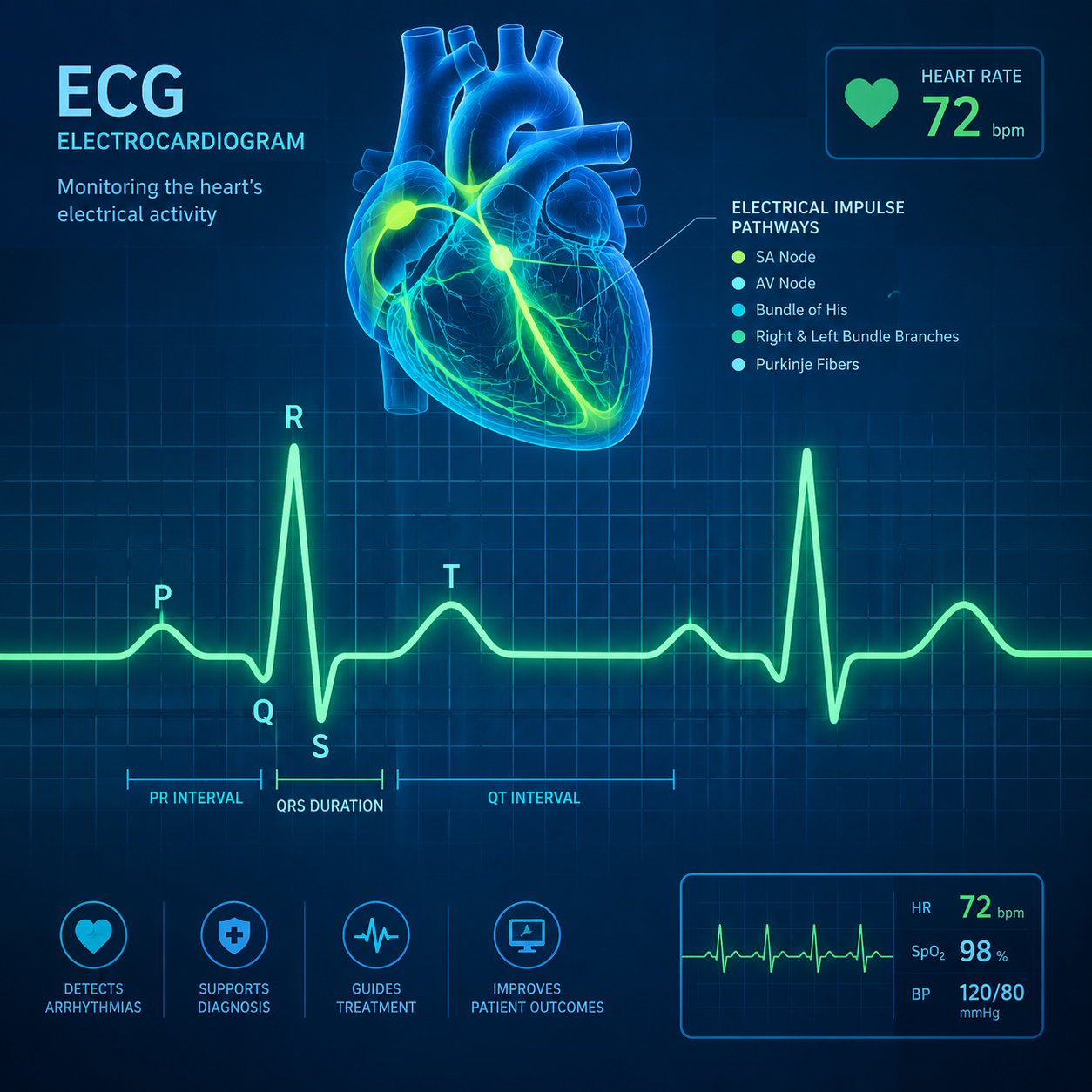
ECG (also called EKG) monitoring measures the electrical activity of your heart. Every heartbeat is triggered by an electrical signal, and ECG captures this signal to show how your heart's electrical system is functioning.
How It Works
ECG uses electrodes to detect electrical impulses on your skin. In a clinical setting, multiple electrodes are placed on your chest. In smart rings like the FUZMORI Medical-Grade Ring, miniaturized electrodes are built into the ring.
What ECG Monitoring Tells You:
- Heart rhythm: Regular vs irregular patterns
- Electrical conduction: How signals travel through the heart
- Arrhythmias: AFib, premature beats, heart block
- Heart rate: Beats per minute (plus context)
- Potential warning signs: Electrical abnormalities
The Advantage
ECG provides a comprehensive view of your heart's electrical health. It can detect conditions that heart rate monitoring alone would miss entirely.
💡 Real-World Example
Sarah, 42, felt occasionally "fluttery" sensations in her chest. Her smartwatch showed normal heart rate (72 BPM). But when she used an ECG-enabled ring during an episode, it detected atrial fibrillation—a condition requiring medical attention.
Heart rate alone would have missed this entirely.
Side-by-Side Comparison
Let's compare what each technology can and cannot do:
| Capability | Heart Rate Only | ECG Monitoring |
|---|---|---|
| Measure beats per minute | ✅ Yes | ✅ Yes |
| Detect heart rhythm abnormalities | ❌ No | ✅ Yes |
| Identify atrial fibrillation | ❌ No | ✅ Yes |
| Assess electrical conduction | ❌ No | ✅ Yes |
| Track heart rate zones | ✅ Yes | ✅ Yes |
| Provide on-demand heart check | Limited | ✅ Comprehensive |
What This Means for Smart Ring Buyers
Understanding this difference is crucial when choosing a smart ring. Here's how it applies to popular options:
Oura Ring (and similar devices)
The Oura Ring and many other popular smart rings use heart rate monitoring only. They excel at:
- Sleep tracking and staging
- Activity and recovery monitoring
- General heart rate trends
- Readiness and stress scores
However, they cannot perform ECG readings. This means they cannot detect heart rhythm abnormalities or provide detailed cardiac insights.
ECG-Enabled Smart Rings
Smart rings with ECG capability—like the FUZMORI rings—offer everything above, plus:
- On-demand ECG readings
- Heart rhythm assessment
- Arrhythmia detection capability
- Comprehensive cardiac monitoring
Who Should Prioritize ECG?
Not everyone needs ECG monitoring. Here's who should consider it a priority:
Consider ECG monitoring if:
- You have a family history of heart conditions
- You occasionally feel palpitations or "skipped beats"
- You're over 40 and proactive about heart health
- You experience unexplained fatigue or dizziness
- You want comprehensive cardiac insights
- You're an athlete monitoring heart health under stress
If you're primarily interested in sleep tracking, activity monitoring, and general wellness—and have no cardiac concerns—heart rate monitoring may be sufficient.
The Bottom Line
Heart rate monitoring and ECG serve different purposes. Heart rate tells you how fast your heart is beating. ECG tells you how well it's beating—the quality and rhythm of each heartbeat.
For general fitness and sleep tracking, heart rate monitoring is valuable. But for comprehensive heart health monitoring—especially if you have cardiac concerns or want early detection capability—ECG provides insights that heart rate alone simply cannot match.
When choosing a smart ring, consider what matters most to you. If heart health is a priority, make sure the device offers ECG capability—not just heart rate monitoring.
📚 Related Resources
⚠️ Disclaimer: Our smart rings are wellness devices, not medical devices. The data provided is for personal reference and lifestyle optimization only. For any health concerns, please consult with a qualified healthcare professional.